


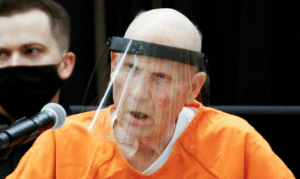
On a quiet night in April 2018, in a seemingly ordinary suburban home in Citrus Heights, California, a man was quietly arrested a man whose name would soon become one of the most horrifying in American criminal history. That man was Joseph DeAngelo. For more than a decade between 1974 and 1986 he terrorized communities across California under a string of terrifying aliases: Visalia Ransacker, East Area Rapist, Original Night Stalker and, when the connections finally became clear, the name that would cement his infamy: Golden State Killer.
This is not a tale of a single crime. It is a chronicle of decades of horror burglaries, rapes, and ultimately 13 brutal murders that haunted victims, families, and entire neighborhoods. But above all, it is the story of how patience, persistence, and modern forensic science finally brought one of America’s most elusive serial killers the infamous “Golden state Killer” to justice.
The Crime Spree That Shook California
From burglary to brutal escalation
Joseph DeAngelo’s criminal history began quietly with thefts and burglaries. In the mid-1970s, as the so-called Visalia Ransacker, he broke into dozens of homes in Visalia, rifling through personal belongings: underwear drawers, women’s garments, small valuables. (Crime Museum)
But violence was creeping in. In September 1975, a break-in escalated when he attempted to abduct a teenage girl her father, journalism professor Claude Snelling, intervened. DeAngelo shot and killed him. That was the Ransacker (DeAngelo’s) first confirmed murder.
From there, Joseph DeAngelo’s crimes lurched into something far darker. By 1976 he had moved toward Sacramento, and the burglaries transformed into violent sexual assaults. For three years from 1976 to 1979 the man who would be known as the East Area Rapist committed at least 40 known sexual assaults on women, initially when they were alone, later expanding to couples. Often, he tied the male partner (if there was one) with kitchen items pressed against him as a warning a modus operandi chillingly consistent.
The Deadly Final Act: The Murders
The most terrifying transformation occurred in southern California, between 1979 and 1986 the era of the Original Night Stalker. During that period, DeAngelo escalated from sexual violence to cold-blooded murder. Investigation and later his own pleas link him to 13 separate murders across multiple counties: Santa Barbara, Ventura, Orange, and more (source) .
Here is a selection of those victims and dates (per court records):
| Victim(s) | Date / Approximate Period |
| Claude Snelling | September 11, 1975 (Visalia) (tulareda.org) |
| Katie and Brian Maggiore | February 2, 1978 (Rancho Cordova / Sacramento area) (tulareda.org) |
| Debra Manning & Robert Offerman | December 30, 1979 (Goleta, Santa Barbara) (tulareda.org) |
| Cheri Domingo & Greg Sanchez | July 27, 1981 (Santa Barbara County) (tulareda.org) |
| Charlene and Lyman Smith | circa March 13, 1980 (Ventura County) (tulareda.org) |
| Keith & Patrice Harrington | August 1980 (Orange County / Dana Point area) (ABC 10 News San Diego KGTV) |
| Manuela Witthuhn | February 1981 (Irvine, Orange County) (tulareda.org) |
| Janelle Cruz | May 5, 1986 (Orange County) believed to be his last known murder (tulareda.org) |
Investigators believe this string of murders was only part of a broader campaign of terror that also included at least 51 rapes and over 120 burglaries spanning more than a decade. (Wikipedia)
One chilling pattern emerges were home invasions at night masked intruders, terrorized couples, often tying up men and assaulting women, sometimes killing both. Some victims later remembered hearing him rummage through refrigerators or eat in their own kitchens an eerie, intimate violation. (Biography)
How He Evaded Capture For Decades
What allowed DeAngelo to slip through the cracks for so long?
- Multiple aliases and changing geographies: Authorities initially thought they were hunting separate criminals the Visalia Ransacker, the East Area Rapist, the Original Night Stalker. That fragmentation of cases made linking the crimes difficult. It wasn’t until much later that investigators realised all were the work of one man. (Historic Mysteries)
- Outdated forensics and investigative limitations of the era: The crimes spanned the 1970s and early ’80s a time before widespread DNA testing, genetic databases, or forensic genealogy. Evidence that might today tie a suspect to multiple crime scenes was at the time insufficient.
- Professional background helped: DeAngelo had worked as a police officer with the Exeter and Auburn police departments. Some reports suggest his knowledge of procedures and law enforcement mindset may have aided his ability to avoid detection. (Biography)
Breakthrough Decades Later
As DNA analysis advanced and technology improved, investigators began to re-examine cold cases. Through forensic genetic genealogy comparing crime-scene DNA with publicly available genealogy databases law enforcement eventually identified distant relatives. This allowed them to build a family tree, narrow down suspects, and focus on DeAngelo. (tulareda.org)
On April 24, 2018, at age 72, Joseph James DeAngelo was arrested. The breakthrough was the result of decades of perseverance across multiple police departments and jurisdictions a testament to how even the most elusive criminals can be caught when evidence, time, and technology converge. (Wikipedia)
The Aftermath: Confession, Trial & Sentencing
Following his arrest, DeAngelo eventually accepted a plea agreement in June 2020. He pleaded guilty to 13 counts of first-degree murder and 13 related kidnapping counts tied to the murders a deal that spared him the death penalty. (ABC 10 News San Diego KGTV)
As part of that agreement, DeAngelo admitted to the murders of all the victims listed above, from Claude Snelling in 1975 to Janelle Cruz in 1986. (tulareda.org)
In August 2020 he was sentenced to multiple consecutive life sentences without the possibility of parole. (Wikipedia)
At sentencing, the courtroom was filled with survivors and family members the voices of those who had waited decades for justice. For many, the verdict offered relief. For others, the pain remained raw, but at least the man responsible was finally held accountable. (ABC 10 News San Diego KGTV)
Why This Case Still Haunts And Matters
The story of the Golden State Killer goes beyond the numbers beyond 13 murders, 50+ rapes, 120+ burglaries. It’s a brutal reflection of how a single individual, moving silently across state lines, can instill terror in countless lives over many years.
It also illustrates how criminal behavior can evolve: what started as theft and voyeurism escalated into sexual violence then into cold-blooded murder. Investigators described the progression as “methodical,” “psycho-pathic,” and terrifyingly organized. (violentminds.com)
The case underlines the importance of persistence in solving cold cases, but also the dramatic shift in forensic tools over time. DNA technology, once nonexistent, became the key that closed one of America’s longest-running serial-crime mysteries.
Finally, it forces society to confront uncomfortable questions: about policing, anonymity, memory, and trauma. Many victims faced decades of fear and silence before hearing the truth. Families carried pain for generations. Communities never truly felt safe.
Remembering the Victims
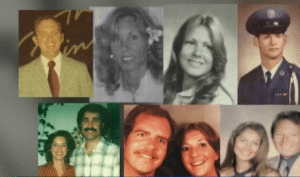
Behind every statistic 13, 51, 120 were real people. Parents, children, sisters, brothers, friends. Their lives cut short. Their sense of safety destroyed. Their families forever changed.
Each victim name whether Claude Snelling, Katie and Brian Maggiore, Manuela Witthuhn, or Janelle Cruz represents a life stolen, a story ended. Their names must not be lost in numbers. Their memories deserve respect.
Conclusion: Justice, Memory, and the Long Shadow of Horror
The arrest and conviction of Joseph DeAngelo the “Golden State Killer” marked the end of one of the most chilling chapters in American true-crime history. What remains is a legacy of pain and a testament to the power of modern forensic science, persistence, and courage in the face of decades-old terror.
But even as justice has been served, the memories of the victims live on, echoing through their families, communities, and the pages of history. And the question remains: in a world where darkness can hide behind an ordinary exterior, how many more stories like this still lurk in the shadows waiting for the truth to catch up?
You may also like to read : The Hunt for Night Stalker : Richard Ramirez

